

Sauber pushes ahead with unique F duct solution

By kineticKid
March 25 2010
If it's true that Alonso is worth 6 tenths in car development, then surely de La Rosa is worth at least 3 tenths in the same regard, as that is what the F duct is speculated to have given McLaren in terms of lap time.
All joking aside, while de La Rosa's experience as a McLaren gave him a solid understanding of how the Woking based squad's system worked, the solution developed in Hinwil is a function of the team's innovation and long-standing willingness to employ new and untested technologies.
Sauber rolled into the Melbourne paddock with a snorkel fitted to the left sidepod of the car above the radiator inlet. Like McLaren, the rear wing slot that makes useful stalling possible was also featured on last year's car. The ducting required for stalling the rear wing on demand is new, however. This can be seen on the spine of the engine cover.
The system differs from McLaren's in that air leaving the duct is blown onto the main profile, as opposed to the upper element. Briefly, the system operates through the opening and closing of a valve which is actuated by a diaphragm adjacent to the driver's braking leg. On the straights, the position of the driver's left leg allows for airflow to be channeled through the car and to the rear wing slot. This airflow disrupts the vortices that trail the wing which induce drag inherent with downforce. When the driver brakes, this air is channeled back into the cockpit for cooling, and the rear wing creates the downforce required for cornering.
Tomorrow's practice sessions should make for interesting viewing as the system is tested for the first time and the team evaluates whether it will be raceable for Sunday's grand prix. Pedro will find out for the first time how the driver actually operates the valve. Surely many teams will be in a rush to develop their own system now that the ingenious idea has been given FIA approval, so the sooner it is race ready on the C29 the better for the Hinwil concern.
If you do not already have an account Click here to Register.
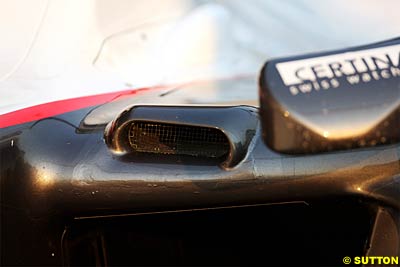
And here the engine cover:

Racing against the machine!
Edited 1 time(s). Last edit at 2010:03:25:09:28:23 by Raid Phoenix.
BTW, howair driver is going to block that air stream in Sauber case? The inlet is on sidepod?
Edited 1 time(s). Last edit at 2010:03:25:10:13:19 by Gemm.
 kidding hats off to Sauber!
An alternative to increasing the angle is to feed air onto the wing to induce stall which otherwise would not have happened. This air come in the open duct by the driver's knees and then is fed and released onto the wing at the back of the car, so that it "stalls" at high speed along the straight which reduces the drag and increases the car's top speed.
OK?
I have made a slight correction to the article, as I was going by AUTOSPORT's original claim earlier today that showed a picture of the existing inlets on the deck of the car, with their assumption that they would be used for the F duct. The snorkel is actually on the left sidepod.
[scarbsf1.wordpress.com]
Quote:
I Scarbs, I was about to post that link!

By the way, you say "Or the duct merely adds mass flow to the exisiting blown slot (raced in Bahrain) to allow the wing to be run even steeper and create yet more downforce."
I don't think it's the case, as it seems the angle is very steep, almost perpendicular to the profile, so it pretty much looks like is indeed trying to detach the airflow with that injection, don't you think?
Racing against the machine!
Great to see you joining our community.
I am big fan of your writing, for many, many years.
gemm
Edited 1 time(s). Last edit at 2010:03:26:09:27:00 by Gemm.
Quote:
Nice to see you here!

Not sure, but the name probably has to do with the shape of the ducting on the Mclaren.
Pedro hinted at an answer to one of the questions I had about the system. If the duct only opens when the driver's knee is lifted, as when he is not braking, how does rear wing created the necessary downforce for corners that are full throttle but create high lateral Gs?
Pedro says the system can be operated by the driver's hand as well, so I suppose he could push a switch (it would have to be a latching switch as opposed to a momentary one since the driver wouldn't have a free hand while cornering). I suppose he could then release the switch after a corner or sequence of corners.
Edited 1 time(s). Last edit at 2010:03:26:19:00:42 by KineticKid.
Sauber didn't expect the FIA would approve a system that could be operated by the driver. When the Macca system was given the green light, they modified their own version because you receive the full effect whenever desired, even on shorter straights.
Edited 1 time(s). Last edit at 2010:03:26:19:15:49 by KineticKid.